


| Vin (Min) (V) | 1.8 |
| Vin (Max) (V) | 9 |
| Vout (Min) (V) | 0.8 |
| Vout (Max) (V) | 8 |
| Regulated outputs (#) | 1 |
| Switching frequency (Min) (kHz) | 250 |
| Switching frequency (Max) (kHz) | 2000 |
| Iq (Typ) (mA) | 1 |
| Features | Enable, Frequency Synchronization, Light Load Efficiency |
| Duty cycle (Max) (%) | 100 |
| Rating | Catalog |
- High-Frequency (2-MHz) Voltage Mode PWM Controller
- 1.8-V to 9.0-V Input Voltage Range
- 0.8-V to 8.0-V Output Voltage Range (Higher in Non-Synchronous Boost Topology)
- High-Efficiency Buck, Boost, SEPIC or Flyback (Buck-Boost) Topology
- Synchronous Rectification for High-Efficiency
- Drives External MOSFETs for High-Current Applications
- Synchronizable Fixed-Frequency PWM or Automatic Pulsed Frequency Modulation (PFM) Mode
- Built-In Soft-Start
- User Programmable Discontinuous or Continuous Conduction Mode
- Selectable Pulse-by-Pulse Current Limiting or Hiccup Mode Protection
- APPLICATIONS
- Networking Equipment
- Servers
- Base Stations
- Cellular Telephones
- Satellite Telephones
- GPS Devices
- Digital Still and Handheld Cameras
- Personal Digital Assistants (PDAs)
The TPS43000 is a high-frequency, voltage-mode, synchronous PWM controller that can be used in buck, boost, SEPIC, or flyback topologies. This highly flexible, full-featured controller is designed to drive a pair of external MOSFETs (one N-channel and one P-channel), enabling it for use with a wide range of output voltages and power levels. With an automatic PFM mode, a shutdown current of less than 1 uA, a sleep-mode current of less than 100 uA and a full operating current of less than 2 mA at 1 MHz, it is ideal for building highly efficient, dc-to-dc converters.
The TPS43000 operates over a wide input voltage range of 1.8 V to 9.0 V. Typical power sources are distributed power systems, two to four nickel or alkaline batteries, or one to two lithium-ion cells. It can be used to generate regulated output voltages from as low as 0.8 V to 8 V or higher. It operates either in a fixed-frequency mode, where the user programs the frequency (up to 2 MHz), or in an automatic PFM mode. In the automatic mode, the controller goes to sleep when the inductor current goes discontinuous, and wakes up when the output voltage has fallen by 2%. In this hysteretic mode of operation, very high efficiency can be maintained over a very wide range of load current. The device can also be synchronized to an external clock source using the dual function SYNC/SD input pin.
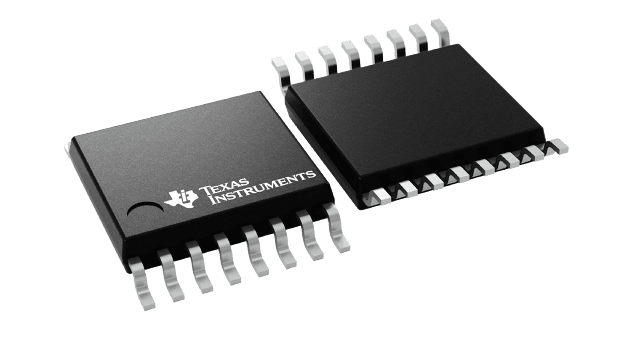
The TPS43000 features a selectable two-level current-limit circuit which senses the voltage drop across the energizing MOSFET. The user can select either pulse-by-pulse current limiting or hiccup mode overcurrent protection. The TPS43000 also features a low-power (LP) mode (which reduces gate charge losses in the N-channel MOSFET at high input/output voltages), undervoltage lockout, and soft-start. The TPS43000 is available in a 16-pin TSSOP (PW) package.